
I have been put out of temporary commission due to another elbow and wrist surgery. Typical of my nature, I started researching topics related to fishing.
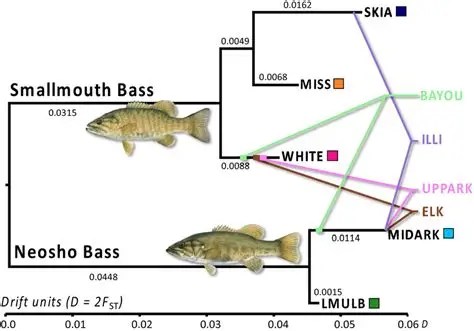
I ran across a podcast from OzarkWeekly and listened to several in a series about the Neosho Bass. Doing subsequent research, I read where this bass was finally designated as a separate and distinct species in 2018. Latest research I found was from 2022. Yes…I’m way behind!
Officially it has been classified as Micropterus velox ( formerly Micropterus dolomieu velox ) and is listed as such in the American Fishing Society’s “Common and Scientific Names of Fishes from the United States, Canada and Mexico 8th Edition.
Genetic studies concluded that it was indeed a separate species that was estimated to have diverged from its sister clade from 1 Million to 6 Million years ago.
I have been wrong on several accounts in regards to the Velox and hope to clarify some of these.
According to the most recent research, a true Velox trophy class fish is rarely over 14 inches. So apparently several of our “trophy specimens” are in fact hybrids. And the hybridization vectors will make your head spin, Spotted bass, Smallmouth bass, hybrid to Velox, Velox to Spotted etc etc.
Tennessee Strain Smallmouth were introduced into Oklahoma starting in the early 80’s and ended in the early 90’s. I’m sure this was an economic decision rather than an ecological one. The damage has been done and is likely irreversible.
Another point of error was that I had read and seen pictures of large smallmouth wedged into tree roots and such, and the researcher postulated that was how they overwintered in the river. More recent research suggests that they actually head downstream to a lake (where available) to take advantage of the thermocline layer. If there is not sufficent rainfall in the spring, then they will spawn at the head of the lake. Of course they aren’t the only fish in the deeper pools and hybridization can and does occur. Also, the hybrids have been found further upstream during each subsequent study. My hunch is that the Velox probably utilizes BOTH tactics to overwinter.
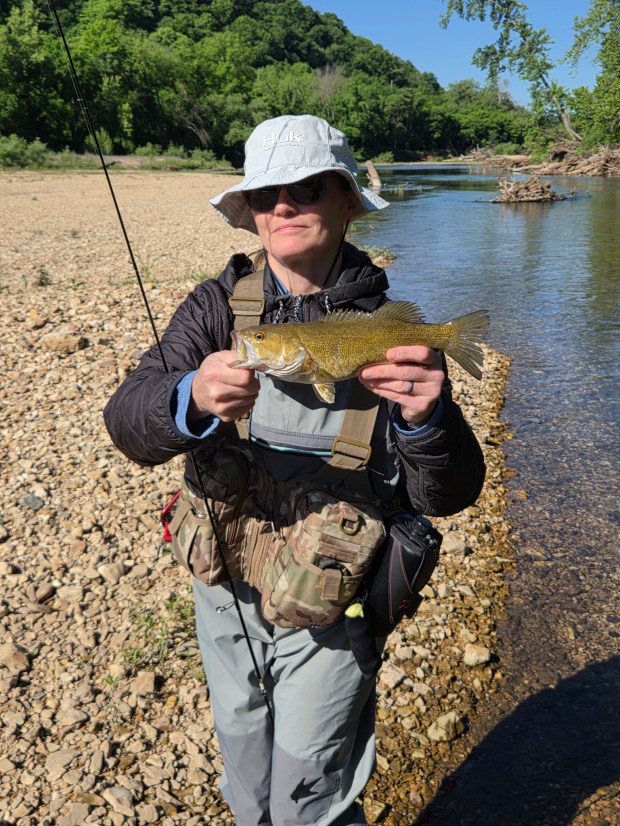
Obviously research is ongoing which is fantastic. I read as many papers as I can get a hold of and continually update my knowledge and skillset accordingly. With the current estimate that the Velox may disappear in 30-50 years, we are so glad that we don’t keep them and instead release them. Granted, a fish of 13-14 inches is past it’s sexual prime and realistically does not reproduce, we still take nothing but photos.
I’m trying to decide if I should overhaul the website in regards to the latest scientific data, or just add some notes to clarify. I will have to think through that fully.
As an aside: we are both still fishing, the weather has been a rollercoaster this spring but when things stabilize, I am certain that the fishing will pick up. We are still working on the house to put the finishing touches to it. Time and money-never enough of either! Take care and we hope to catch you on the next one.


